Introduction
The Bakossi National Park (BNP) is unique hotspot of biodiversity species. The park accommodate threatened species of primate, including the Drill (Mandrillus leucophaeus), one of the most endangered primate species in the world, and the Chimpanzee (Pan troglodytes). Other primates include Preuss’s monkey, Red colobus, Red-eared guenon, Preuss’s guenon, Putty-nosed monkey, Mona monkey and other important mammals like Blue duikers, Red river hog, Red-fronted duiker, Black-fronted duikers, and Long tail pangolin. The park is surrounded by 34 villages that derive their livelihood within the forest and its surrounding. In the cause of making use of the natural resources in the forest, their activities tend to destroy the forest either intentionally or unintentionally.
Since the park was established by Prime Ministerial Decree N° 2007/1459/PM of 28 November 2007, communities’ access rights and uses of natural resources in their forest have been limited. In order to reconcile conservation actions with community activities in the forest, FORUDEF through WWF-Cameroon in Leading the Change: Civil Society, Rights and Environment has been supporting the 34 villages with green livelihood alternatives, one of which mini cassava grinding machines. So far 12 cassava grinding machines have been donated to women groups in the South West, North West, North East Clusters of the BNP.
Cassava being one of the food crops in villages around the BNP area, it is processed to cassava paste “water fufu” and garri and this often entails hard labour, time consumption and postharvest loses. This activity is mostly done by women and youths. The cassava grinding machine has reduced some of these challenges mentioned above. In order to add value to cassava products, and to reduce human pressure in the park, FORUDEF mobilized women in the South West, North West and North East Clusters for a training workshop.
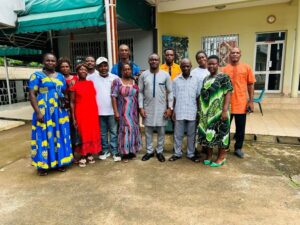
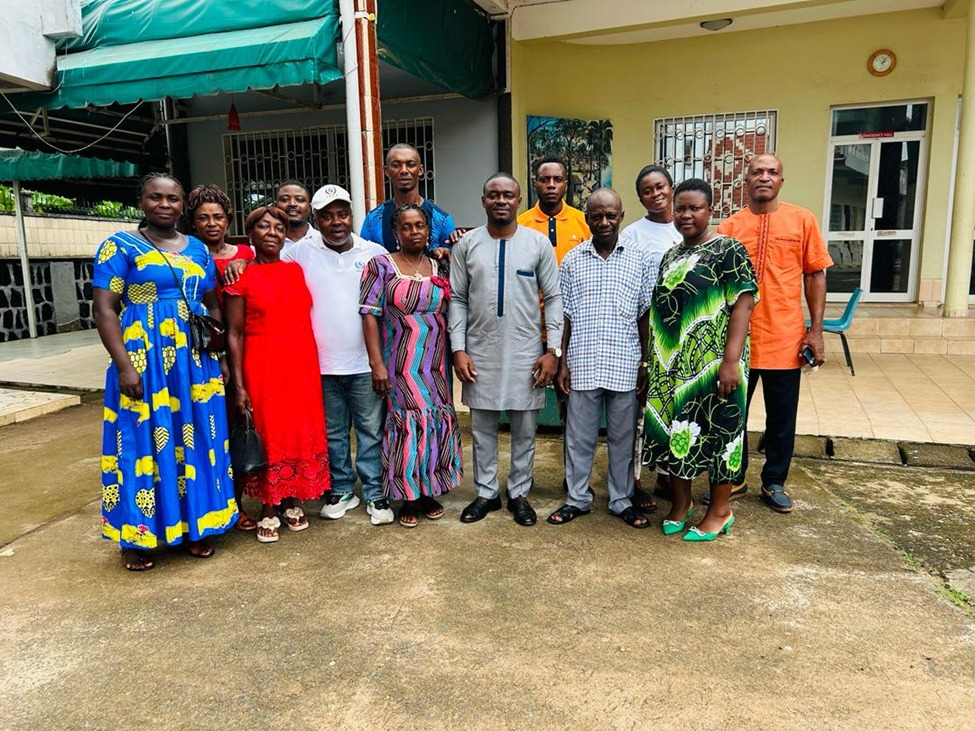
Two women each from communities alongside their cluster chairman in the South-West and North West and North East clusters that benefited from cassava grinding machine were mobilized and invited to a workshop that took place in Limbe on the 16th and 17th of May 2024. This workshop was to engaged local communities in particular women and youths on sustainable natural resources management, influencing decision making processes and benefiting equitable from natural resources.
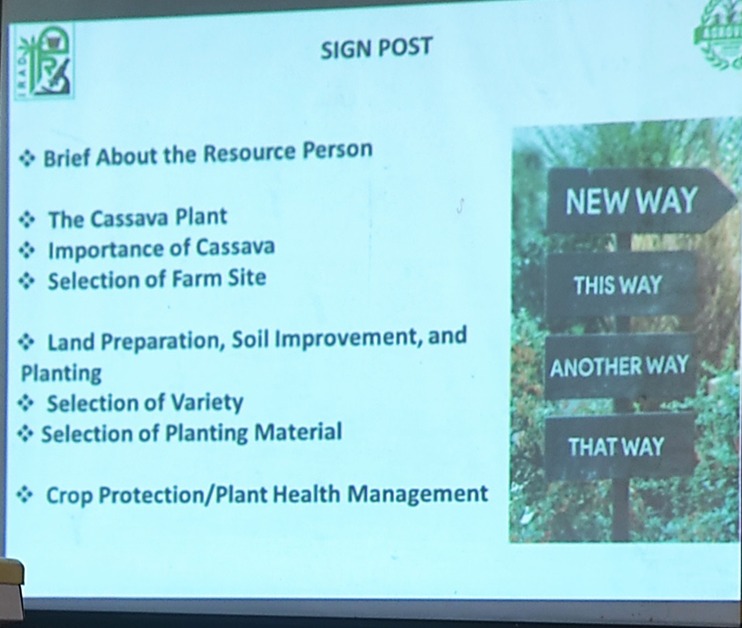
Using a projector the facilitator made PowerPoint presentations on the first level of the cassava value chain which is the cassava plants, best practices to setup a cassava farm and the management of pest and diseases. The presentation was interactive as participants shared their experience on cassava farming and how they transform the cassava into other products.
Each chairpersons from the clusters explained how their benefit sharing mechanisms for the cassava grinding machines works and those that do not have were asked to elaborate theirs following the example of the South West Cluster.
Results
The workshop that took place on the 16th and 17th of May 2024 in Limbe brought together participants ( 5 women and 4 men) from the North West, South West and North East Cluster of communities around the Bakossi National Park. Also present were 3 FORUDEF staff, the Divisional Delegate of Agriculture for Kupe-Muanengouba and a resource person who conducted the training on cassava value chain addition, more specifically on cassava farm setup and pest and diseases control. The following were discussed during the training.
The Cassava Plants ( Manihot esculenta)
- Is the third largest source of food carbohydrates in the tropics and rice and maize.
- Cassava is a major staple food in the developing world.
- It is one of the most drought-tolerant crops.
- Capable of growing on marginal soils.
- Has edible roots and leaves.
- Cassava leaves are a rich source of protein, minerals, and vitamins.
- Can be harvested in 9-18 months.
Importance of Cassava
- Edible plant, good source of dietary fiber, leaves are a rich source of protein, minerals and vitamins
- Roots are process to cassava flour, breads, tapioca, and laundry starch.
- Alcoholic beverage is derived from cassava roots.
- Cassava starch is use as a binding agent in pharmaceutical industries.
- Use in the manufacture of soap and detergent.
Selection of farm site
- Well drained loamy soil the best soil for cassava cultivation. It is rich in nutrient, low in gravel and retains water in the soil, easy to work and till. Sandy and clay soil not very suitable for cassava cultivation.
- The area should have adequate rainfall
- Warm and moist climate,
- Thick vegetation cover, dark with lots of organic matter.
- Flat and gentle slopes are good. Avoid sites with water logged areas such as marshy areas, flooded areas, valleys.
- Check previous history of the site, for example if it was invested with crop pest or diseases.
Land preparation
- The land area selected should be weeded manually or using chemicals.
- After about 5-7days, till area with machine or make planting beds or mounds using hoe.
- Select suitable planting date (beginning of rainy seasons preferably).
- Apply manure or fertilizer on planting beds before planting of cassava cuttings.
Soil improvement/ fertilizer management
- Apply manure or organic fertilizer at land preparation to, i) increase soil nutrients, ii) improve soil structure and iii) improve ability of soil to hold water. Use organic manure such as: fowl dung, composted plant materials, green manure (egusi, ground nuts, beans, mucuna).
- Green manure improves soil properties.
- Inorganic manure can also be added to the rate of 400 kg NPK per Ha.
- Liquid fertilizers with NPK can also be used.
Selection of cassava varieties
- Get good varieties from experts.
- Best varieties are:
- Like by consumers
- Grow fast
- Give good yields
- Store well in the soil.
- Tolerant to major pests and diseases.
- Have high dry matter (greater or equal to 30%) and good food quality.
- Good mealiness (cooked without processing (sweet variety)).
- Early mature or early bulking varieties.
- Ability to stay long in the soil without getting spoiled.
Selection of good planting material
- Stem cuttings are used as planting materials.
- IRAD, SOWEDA, MINADER, Private Business Persons, Cooperatives/CIGs/Associations.
- Many pests and diseases are on the stem, therefore facilitate spread.
- Gets stems of plants that are vigorous and healthy (9-15 months old).
- Avoid plants with pests and/ or diseases.
- Stem cuttings should be 20-25 cm long with 5-8 nodes.
- Get stem cuttings from varieties of your interest.
Planting
- Select suitable planting dates, beginning of rainy seasons (April-May).
- Use suitable land and planting mount/bed.
- Carefully transports stem cuttings to avoid damages on nodes.
- There are two main planting styles: Vertical at an angle or horizontal.
- Vertical: roots develop deeper and closer in soil; is more difficult to harvest; good for loam soil, and high rainfall.
- Horizontal: Good in dry areas, roots, develop more closely to the surface, several weak stems develop.
- Planting spacing is 1m x 1m (monoculture).
Post-planting measures (Plant health management)
- Weed management
- Remove weeds within the first 3 months to prevent competition of nutrients, light and space.
- Do hand within or use a contact herbicide.
- Generally weed at 4,8,12 weeks after planting.
- Fertilizer management
- Carry out soil test before planting to determine type and dose of fertilizer.
- Use of fertilizer must be cost effective.
- It requires N, P, K and some micro elements (B, Mn, etc) for best growth.
- Less than 15 tons per hectare apply fertilizer but more than 20 tones do not apply.
- If you do not carry out soil test, the following is recommended:
- NPK 20:10:10 after 3 months at rate of 5g per plant or
- Yara complex at rate of 5g per plant.
- Organic manure such as poultry dung or oil palm bunch residue ash can be applied at 50-100g per plant.
- Liquid fertilizers and bio-stimulant can be used.
- Pest management
- Identification of major pests and their management cassava Mealybug (Phenacoccus manihorti).
- Commonly found in shoot tips, found under surfaces of leaves.
- It injects poisons into the plant making it dry and die.
- Cause chlorosis, stunting, leaf deformation, and early leaf dropping.
- Causes about 60% loss of plants.
- Management and control
- Control ants using insecticide.
- Apply neem products.
- Use chemicals such as chlorpyrifos (4ml/L of water) or Dimethoate (2ml/L of water).
- Use Rata (garlic-neem formulation).
- Cassava Green Spider Mites (Mononychellus tanajoa)
- Green in young age but yellowish as adult.
- Attack very serious during dry periods/seasons.
- Mostly affects young roots and shoots.
- Cause tiny yellow chlorotic spots on upper leaf surfaces.
- Can reduce yield by 14-80%.
- Management and control
- Destroy infested plants.
- Use plats essential oil, e.g citrus and garlic.
- Apply Rata (garlic-neem formulation)
- Can use insecticides such as Abamectine or combination of Lambda cyhalothrine and thiametoxam.
- Variegated Grasshopper (Zonocerus variegatus)
- Important pest of crops with green and yellow patches on the body.
- Feeds on cassava leaves and stems.
- Damage more serious on older crops and in the dry seasons.
- Young ones like to rest on chromolena odorata grass.
- Management and Control
- Apply contact insecticides like Chlorphyrifos, cypercal.
- Apply neem products or Bt products.
- Remove chromolena
- Whiteflies (Bemisia tabaci)
- Important piercing-sucking pest of crops.
- Sucks liquid/sap out from the leaves.
- Cause leaves/plants to wit and die.
- Cause black coloration of leaves and reduce photosynthesis.
- Important vector: transmit virus that cause O2 main diseases: (i) Cassava Mosaic Disease-CMD, (ii) Cassava Brown Streak Disease-CBSD.
- Management and control
- Apply contact/systemic/stomach insecticides like Magic force which is Dimethoat +Thiametoxam.
- Apply Rata (neem-garlic based product).
- Irrigation reduces infestation.
- Identification of major diseases and their management
- CMD: Cause by a virus transmitted by Whiteflies.
- Can get into farms via infected plant materials.
- Severe on young plants than older ones.
- Manifestations on leaves are: leaf reduction, chlorosis, distortion of leaves, stunted growth, twisted leaflets, and reduction of size of leaves/plants.
- Cause high yield loss.
- Management and control
- Control Whiteflies.
- Field sanitation.
- Use clean/healthy plant materials.
- CBSD: Cause by a virus transmitted by Whiteflies.
- Can get into farms via infected plants materials.
- High yield loss due to necrosis of roots (70% losses).
- Symptoms: leaf chlorosis, brown streaks on stems, dry hard rots on roots that severely affects quality and quantity.
- Management and control
- Same as CMD.
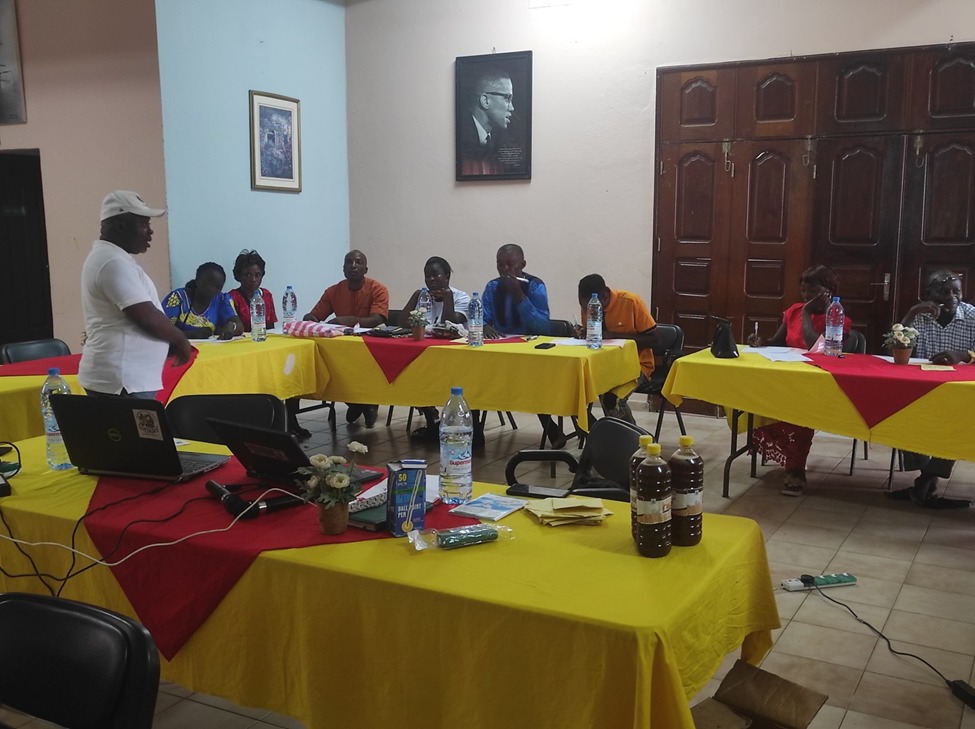
Resource person explaining to participants during cassava value chain addition workshop in Limbe, 16th and 17th of May 2024.
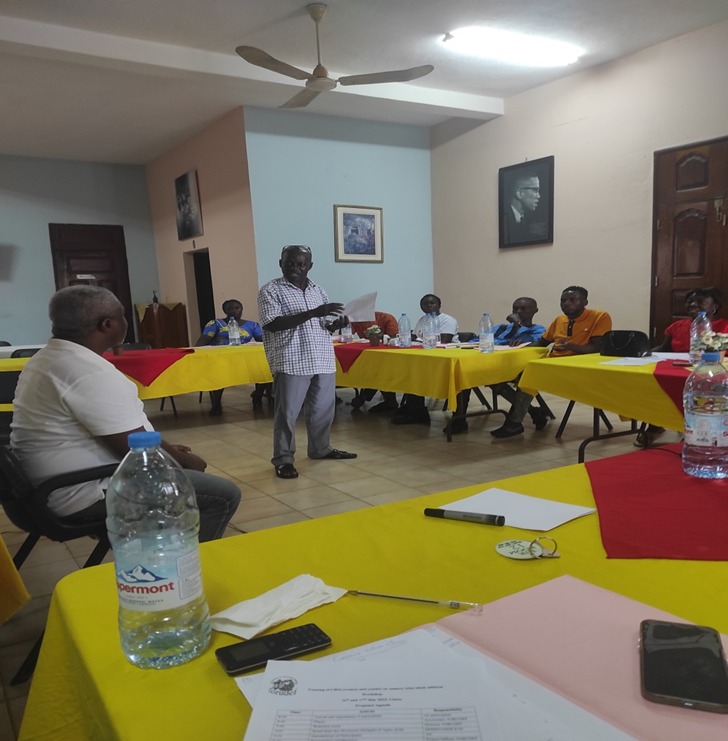
Participant sharing his experience during the cassava value chain addition training in Limbe, 16th and 17th 2024
Benefit sharing mechanism (BSM) for mini cassava grinding machines of the CBOs
The 3 CBOs (South West, North West and North East Cluster) that participated at the training have distributed a combined 12 cassava grinding machines to women groups in their communities. In order to ensure the effective management and equitable benefit to all members of the communities, each of the clusters have put in place a benefit sharing mechanism for their cassava grinding machine. The South West Cluster has already started implementing the BSM by the machine is handed to women group, they assigned and operator to carryout cassava grinding in the community and the cluster plays a supervisory role. Income generated while grinding cassava in households is shared as follows: 40% for maintained and operation, 30% goes to the cluster for daily function, 30% to the women groups.
Conclusion
This report highlights the training on cassava value change addition that took place on the 16th and 17th May 2024. Present during the training were 5 women and 4 men from the North West, South West and North East Cluster of communities around the Bakossi National Park, the Divisional Delegate of Agriculture for Kupe-Muanengouba, 3 FORUDEF staff and a resource person. Participants acquired knowledge on the first level of the cassava value chain. They learned that cassava is one of the most used carbohydrates in the tropics, and has much importance that can be exploited for economic purposes. They also learned how to cultivate and maintain a healthy cassava farm. Participant shared their experience on benefit sharing mechanism based on the use of cassava grinding machines and also learned on improving the mechanism for better implementation.